
COLUMN | Gun Violence Didn't Move to Seattle Center. Our Attention Did.

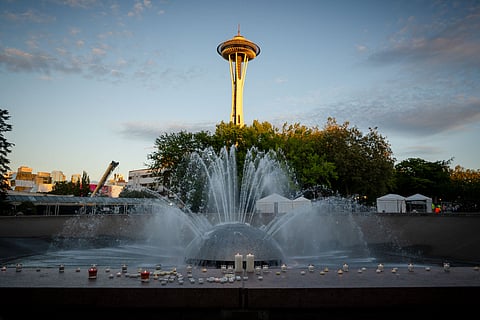
By the time the vigil began Monday night at Seattle Center, in remembrance of the shootings at the Bite of Seattle, I already knew I wasn't only grieving the people who died there.
I was grieving the people our city had already forgotten.
The names spoken that evening deserved every tear. Carlos Israel Sanchez Villalba. Ashley Whitehead. Junior Cee Niko Semo. Their families deserve every embrace, every candle, every promise that Seattle will not look away.
A 2-year-old boy is in a hospital bed as I write this, and I will not use his suffering as a rhetorical warm-up before pivoting to my real argument, the way so much of this city's commentariat already has. The victims deserve better than to be a preamble.
But as the crowd stood in silence, my mind kept drifting south. To Rainier Beach, where two high school students were killed in January. To Hillman City, where a teenager allegedly killed another teenager in May. To Brighton, where a 19-year-old was killed in a May drive-by shooting. And to all the families who buried children without a New York Times alert, or without elected officials flanked by a bank of cameras, or without a single essay comparing our civic soul to San Francisco's. The South End often buries its dead in the quiet that the rest of the city reserves for the poor and the Black. Unseen and often unheard.
There are accounts this city keeps, where it decides which deaths will interrupt regularly scheduled programming and which deaths simply skirt by it. It lives in which neighborhoods get a swarm of sustained media attention and which get a candlelight circle by a bus stop that fails to resonate beyond Henderson and Rainier Avenue. And so again this week, we were reminded whose grief would be treated as a civic emergency and whose is always treated as provisional.
If you are only capable of outrage when the blood spills in Lower Queen Anne, your outrage was never about the blood. It was about which neighborhood is forced to watch it senselessly spilled.
—Marcus Harrison Green
The shooting at Seattle Center became national news because it happened in one of the city's civic living rooms, interrupting the story we prefer to tell about who violence happens to and where it belongs — something we imagine confined to other neighborhoods and other lives until it crosses an invisible border and becomes, suddenly, everyone's problem. That is asymmetric compassion. Please let me be clear: It is not that the Seattle Center victims received too much empathy. It's that too many others have received too little for so long that many in our city no longer notice the withholding as a choice.
I cannot pretend to witness what is now happening, because I have watched it happen before. Within a day of the shooting, a crowded field of corporate media and investment-banker Substackers, few of whom have spent an afternoon in a violence-interruption meeting or read a page of criminology, will have already found in three fresh bodies the confirmation of whatever they believed on Saturday morning: a depleted police force, a soft-on-crime council, and a city that "stopped enforcing the law." Read, watch, or listen to this commentary closely and you will find the old sorting logic underneath them, dressed now in the language of spontaneous concern — that a city grows dangerous when it stops punishing the poor for being poor. This argument was written before the shots were fired. The shooting was simply the occasion for publishing it.
Here is what that argument requires you to forget. Homicides in this city are down 31% this year. June was the first homicide-free June in six decades. Overdoses have fallen by a third since 2023, yet the notorious "open air drug markets" remain. What changed was wider access to treatment and overdose-reversal medication. Public health has never argued that criminalizing addiction saves lives; the evidence runs the other way, showing that scattering people from familiar dealers into an unfamiliar, more contaminated supply gets more of them killed, not fewer. None of this fits the sermon about lawlessness. So the sermon simply omits it.
If you are only capable of outrage when the blood spills in Lower Queen Anne, your outrage was never about the blood. It was about which neighborhood is forced to watch it senselessly spilled.
Ask instead what a 15-year-old is missing before he picks up a gun. Perhaps, housing. Perhaps, food security. Maybe a brain that childhood hunger hasn't shortchanged. Ask why Washington still permits an adult to leave a firearm unsecured, while no teenager can buy one over a counter, which means, every time a teen is armed someone older has failed to keep it locked away. Ask why a city can argue for months over whether hungry children deserve a free lunch, and never once argue that long over another platoon of officers whose presence would not have stopped two people who knew each other from drawing on one another in a crowd.
This was not, by early accounts, a stranger with a grievance against the world, the way Cafe Racer was in 2012. That distinction is critical, not to soften what happened, but because it means this was the ordinary violence this city has decided for years belongs somewhere else, surfacing where we had trained ourselves not to look.
Cities that have actually driven violence down did not do it by choosing enforcement over prevention. Baltimore, of all places, just posted its fewest homicides in nearly 50 years, down 31% in a single year, down almost 60% since 2021, and not by policing its way out, but by pairing targeted enforcement with jobs programs, rebuilt schools, new rec centers, and a violence-intervention strategy aimed at the small number of people most likely to shoot or be shot.
Be furious. I am. But aim your fury beyond the child who picked up the gun and toward the conditions that shaped him long before he ever held one. It is easy to demand more prisons, more patrols, and harsher sentences. Any city can do that. Far fewer are willing to build the schools, parks, jobs, relationships, and community that make those prisons less necessary in the first place. One is the politics of performance. The other is the harder work of preventing grief before it begins.
Marcus Harrison Green is the founder of the South Seattle Emerald.
No Paywalls. No Billionaires. Just Us.
We're building a newsroom rooted in community, not corporate backing. Help us raise funds to hire our first-ever full-time reporter and grow our capacity to cover the South End. Donate today.
