
COLUMN | Civil Verdict Against Raz Simone Raises New Questions About Seattle Police
Seattle rapper and former self-proclaimed activist Raz Simone was recently found liable for criminal profiteering in a civil case by a King County court.
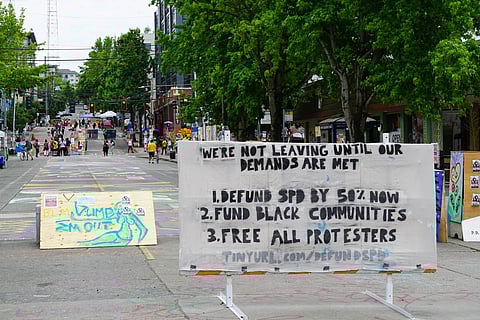
As I wrote in 2022, Simone was portrayed by national media as a leader of the Capitol Hill Occupied Protest (CHOP) in 2020 despite persistent opposition from activists on the ground. His elevation was not organic. Many believed in real time that amplifying him served to discredit the broader 2020 racial justice protests in Seattle — a familiar tactic used to discredit social justice movements.
In the years after CHOP, multiple women reported allegations of trafficking and abuse against Simone to the Seattle Police Department. No charges were filed.
Now, even without a conviction in criminal court, four of his victims have had success in a civil suit.
"I got a case from a colleague of mine involving Simone. And it was basically a fraud case," said attorney Ellery Johannessen. What began as a relatively straightforward property and fraud dispute, in 2021, soon expanded. As Johannessen dug into Simone's background in an effort to identify assets to attach for a potential judgment, he came across reporting by KUOW detailing trafficking and abuse allegations. He reached out to several of the women quoted in that coverage.
What followed was years of investigation, a monthlong trial, and ultimately a civil judgment awarding four women $2.1 million.
Before the inevitable wave of anti-activist commentary attempts to use this verdict as proof that CHOP was inherently criminal or corrupt, it's important to be clear: The verdict reflects his conduct, not the movement to support Black lives.
At the same time, the fact that this accountability came through a civil proceeding rather than a criminal prosecution raises difficult questions. The conduct described in court, particularly the trafficking-related allegations, would ordinarily fall within the scope of criminal law. Yet despite multiple reports over several years, no criminal charges were brought. Survivors were left to pursue justice on their own.
These findings are not an indictment of CHOP. They are an indictment of the City of Seattle's pattern of undermining racial justice movements, and they raise serious questions about the Seattle Police Department's failure to act despite years of reports. They also reflect a broader culture that too often dismisses women's warnings, whether from survivors or organizers.
While Simone styled himself as a liberation figure, allegations of abuse and trafficking were already circulating. Women organizers sounded the alarm early. They were vocal and direct and largely ignored.
This is not revisionist history.
Despite media sensationalism that often painted the protests in the worst possible light, objections to Simone were fierce and well documented. On June 24, 2020, I stated publicly: "Raz is no leader of mine and that can't be overstated. It's important for me, personally, to be unequivocal and on the record with this." That statement was shared on Twitter and later printed in the 2021 KUOW article.
Simone's violations against vulnerable women was one reason organizers raised concerns. After hearing directly from survivors, women organizers in particular warned the broader community. But there was another issue that troubled many: his apparent proximity to law enforcement and city leadership.
We now know that at least eight people reported trafficking allegations involving Simone to Seattle police as early as 2017. Why didn't SPD act?
Johannessen also attempted to bring a case against SPD on behalf of Simone's victims, arguing that police had made Simone aware of the claims against him but failed to intervene. "Our position was that SPD had created an unnecessarily hazardous situation that actually increased the risk of harm for the women who were still with him," he said. That claim was dismissed under the public duty doctrine, a legal principle holding that government entities and their employees owe duties to the public at large, not to specific individuals.
Still, with the volume of evidence presented in the civil case, the absence of criminal charges raises red flags. "My own belief is that I think law enforcement would have been successful if they tried to bring this case," Johannessen said. "I can't see why they didn't."
Despite this, national outlets continued framing him as a CHOP "leader." Public records later revealed documented communication between him and city officials during the protests. Yet city leadership never clarified the extent of that contact, even as media narratives crystallized around the image of him as the so-called "warlord of CHOP."
If he was, in fact, installed in the protest movement, that fits into a longer historical pattern. Law enforcement agencies have repeatedly relied on compromised individuals as informants or intermediaries to penetrate movements. Back when she was the U.S. attorney, former Mayor Jenny Durkan used a sex offender, convicted of child molestation and rape, as an SPD informant to infiltrate the Seattle protest scene. Nationally and historically, similar tactics were used, as in the instance of the Chicago chapter of the Black Panther Party, where infiltration helped set the stage for the 1969 police killing of Chairman Fred Hampton.
We may never know the full extent to which the city benefitted from its communication with Simone in 2020. What is clear, however, is that his criminal conduct became convenient cover, allowing critics to shift attention away from state violence and toward activist dysfunction. Protesters were left answering for someone many had quickly rejected.
That dynamic is doubly harmful. Movements are weakened by bad actors, and then participants are forced to defend themselves against the very sabotage they warned about.
Simone's survivors deserve justice, and it matters that they are receiving some measure of justice. Holding him responsible strengthens movements that demand accountability from institutions of power.
If anything, this verdict deepens the scrutiny on SPD's yearslong inaction and on city leadership's decision to engage with and legitimize him while remaining silent as misleading narratives took hold. It underscores a flawed approach to protest management that prioritizes political optics over public safety.
Serious questions remain. What did SPD know, and when? Why were earlier reports not pursued? What were the full contents of communications between Simone and city officials?
As coverage of this verdict unfolds, the public must firmly rebuff media and political efforts to use it as retroactive validation of earlier attacks on the movement — an argument that is both factually inaccurate and a convenient cop-out that avoids scrutiny of those in power.
The real takeaways are these: We must continue to demand transparency from those in power, reject politically motivated revisionism about the 2020 protests, and believe women when they raise concerns, especially when doing so carries personal risk.
Gennette Cordova is a writer, organizer, and social impact manager.
No Paywalls. No Billionaires. Just Us.
We're building a newsroom rooted in community, not corporate backing. Help us raise funds to hire our first-ever full-time reporter and grow our capacity to cover the South End. Donate today.

