
COLUMN | Seattle Had No Homicides in June. Don't Use It to Justify More Policing.

Chalk it up to World Cup vibes, or to Seattle under socialism if that's the story you'd rather tell. But the plain fact is this: Our city did something last month it hasn't done in 56 years — we went the entire month of June without a homicide.
Seattle Police Chief Shon Barnes called it a reminder of what the city can do when everyone rows in the same direction. I suppose. But there is a particular danger, in this moment, of a good month becoming a bad argument, and of our good fortune being conscripted into a mandate for more of what has always failed us.
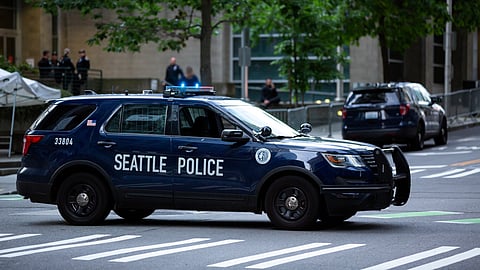
Good news, in this country, has a way of being marched into service of whatever story already has the most institutional weight behind it. And the story that we need more policing, whatever the cost, carries plenty of that weight right now. Seattle's police department will finish the year with roughly 1,250 officers, with hopes of reaching 1,400 by 2029, a return to staffing levels last seen before 2020. Its budget, near $490 million, is already the largest line in the city's general fund and is, by the chief's own admission, on track to overspend it.
When asked about slowing hiring to fit the budget, Public Safety Committee Chair Bob Kettle rejected the idea outright. Meanwhile, the city stares down a hole of at least $175 million, and every other department has been handed a pair of scissors and told to cut into its bones.
Here is what should give us pause: June happened without the fully staffed department some officials insist we need, in a city that spends less on policing than many peers, and during a month where four major sporting events drew more tourists than Seattle has ever seen. If staffing alone explained safety, this milestone should have arrived years ago, when the department was larger. It didn't. That is not an argument against police, but it is an argument against the oldest reflex in American politics, treating police spending as untouchable while everything else must justify its existence.
We see patrol cars, but not the violence interrupter who talked someone into walking away before a trigger was pulled. We see arrests, not the resource navigator who kept a grieving teenager enrolled in school. We see press conferences announcing the apprehension of a "suspect," not the tutor, the coach, the auntie, or the mentor who made the press conference unnecessary. Prevention leaves no visible monument. It produces something so ordinary we hardly notice it: another uneventful Tuesday. And because it is invisible, it is the first thing cut when budgets tighten.
Then came this week. Only days after Seattle celebrated a homicide-free June, at least six people were injured in three South Seattle shootings in a single night. Reality has a way of rejecting simple narratives. And even as the city touts a new $14.7 million investment in community safety, Community Passageways, the organization whose case managers helped a senior survive foster care and graduate high school, is losing up to 13 staff members in Rainier Beach because its contract wasn't renewed. How wonderful of us to applaud the harvest while debating whether to pull up the roots.
Every dollar carries an opportunity cost: Every dollar spent responding to violence is a dollar unavailable for preventing it. We treat the police budget the way this country treats its military budget — sacrosanct, and beyond debate, while housing, prevention, and health care stay on the table for cutting. Lawsuits over officer misconduct have cost this city more than $20 million in five years, a cost that draws nowhere near the scrutiny a nonprofit's grant renewal receives.
Prevention leaves no visible monument. It produces something so ordinary we hardly notice it: another uneventful Tuesday.
—Marcus Harrison Green
The lesson of June is not that Seattle solved gun violence. It didn't. Nor is the lesson that one peaceful month proves any single strategy correct. The lesson is humility and that safety is not the product of one institution but the accumulated, often invisible, work of many. Budget season is coming, and the choice before the council and the mayor is not between safety and no safety. It is between a theory well-funded for decades that cannot, by its own accounting, explain June, and one chronically starved that may have quietly helped produce it. A community safety portfolio, not a policing monoculture, is what got us here.
A city is not made safe by a single tower, any more than a house is made whole by a single wall. Safety is found in the whole architecture, visible and invisible, funded and unfunded, honored and unmentioned. We should not need another headline, or another night of gunfire, to remember that. Let us learn it now, while the lesson is still cheap. Because the cost of learning too late is almost always paid by the life of someone who never volunteered to teach us.
Marcus Harrison Green is the founder of the South Seattle Emerald.
No Paywalls. No Billionaires. Just Us.
We're building a newsroom rooted in community, not corporate backing. Help us raise funds to hire our first-ever full-time reporter and grow our capacity to cover the South End. Donate today.
