
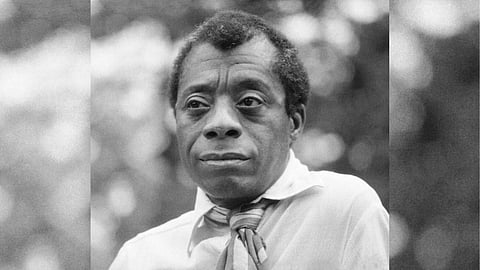
OPINION | It's James Baldwin's Birthday. We Need His Wisdom Now More Than Ever.
As a closeted, white high schooler growing up in Seattle, I found refuge in James Baldwin's novels. Giovanni's Room, in particular, with its claustrophobic title, reflected my own closet, because David, the protagonist, is a white queer American traveling in Europe who attempts to find himself and escape his family. If Baldwin could defy the odds of 1950s Cold War politics and come out of the closet, then it should've been easier for me growing up in Seattle in the 2000s.
Baldwin, born Aug. 2, 1924, in Harlem, New York, is a Black queer writer, orator, and civil rights activist. It pains me to write that sentence because he hated labels. Baldwin's legacy is complicated, some lost to history, other parts censored, while some pieces sit in boxes, restricted from public access for decades to come. Speaking of those boxes, when I was freshly out of the closet, living in NYC for graduate school, I conducted research at the Baldwin archive in Harlem. It was there, in the neighborhood where he was born and his legacy lives, that I learned Baldwin defied more than the closet of the Cold War, but was tracked through a covert operation by the CIA, and more. Baldwin shows us that while attempts at censorship and persecution will try to keep us closeted, these boxes and false binaries certainly can't keep us contained.
I recently picked up his 1957 short essay "Princes and Powers," looking for answers on how to navigate the most recent smear campaign of queer and socialist politics, reminiscent of the Cold War. The piece was first published in one of the many literary journals in Europe, one funded by an anti-communist group established by the CIA during the Cold War. Baldwin had no clue about CIA involvement. Nevertheless, this essay's message is still radical.
For readers like me, Baldwin's prolific critiques of racism and anti-Blackness provide an all-too-relevant analysis of whiteness. Baldwin spoke to all with his examination of Blackness, interracial solidarity, sexuality and masculinity, nation and colonization, and the closet. In "Princes and Powers," Baldwin, much like David in Giovanni's Room, finds himself reflecting on being an American in Paris in 1956 and the box that comes with nationalism. The essay opens with Baldwin recounting a panel discussion at the First International Congress of Black Writers and Artists, which he attended in Paris. A message from W.E.B. Du Bois, who could not make it, was read aloud: "I am not present at your meeting because the U.S. government will not give me a passport." The message continued, "Any American Negro traveling abroad today must either not care about Negroes or say what the State Department wishes him to say."
In the essay, Baldwin turns what could have felt like a personal attack into a beautiful reflection: "The fact that Du Bois was not there and could not, therefore, be engaged in debate, naturally made the more seductive his closing argument: which was that, the future of Africa being socialist, African writers should take the road taken by Russia, Poland, China, etc., and not be 'betrayed backward by the U.S. into colonialism.'"
Reading those words now at 35 and thinking back to the secrets of Baldwin's archive, I become angry for the little boy who couldn't come out because history hadn't let his heroes come out yet either. But if Baldwin could beat the odds, move to Europe, live a queer life, and become a socialist in the 1950s — while his publishers were secretly working with the CIA, the FBI tracked him, and publishers censored him — then we can bring his legacy home in the 21st century.

As an activist and organizer since college, one inspired by watching Bernie Sanders almost win 10 years ago, I've personally observed and done harm rooted in white supremacy. After 2020, many of us have fallen silent on the topic. And just like white gays have struggled with balancing the line between cultural appreciation and appropriation, so has the left. We whites, queers, and the left have been called out, we've been canceled, but some of us are not giving up on the fight for collective liberation.
Rereading Baldwin helps me consider recent New York Times headlines like "I'm Gay, Not Queer" and see through the false binary. The cis-white-led cult of apolitical apologists reeks of Cold War respectability politics, calling queers "radicals" like it's a new slur — recasting the closet to incorporate more than just sexuality, but politics. Sure, we have Pete Buttigieges on one side and James Baldwins on the other, but it's all a spectrum — and last time I checked, healthcare, housing, food, and education are not that radical.
The state department, and Democratic and Republican pundits, of course, disagree. Listing Democratic Socialists of America as "front groups" for Cuba is what happens when the two-party system is threatened by an alternative. The binary system pits us against each other to distract us from our shared rage. The rage we feel is justified as citizens living under the empire of the U.S., the richest country on Earth, which is unable to feed our children and unwilling to do anything to change it.
But Baldwin beat back political nihilism with every word. He refused labels because he knew they would be used against him. He turned his rage into something beautifully defiant and helped us see that what's worse than being forgotten, censored, or persecuted by history is being on the wrong side of it.
Our political spectrum doesn't just run from Democrat to Republican. Across the country, socialism isn't sounding so scary anymore. The establishment's response? Fearmongering and whitewashing the left as a bunch of "white radicals," while erasing the Black origins of America's left. It's a trick they've used before, and also there's some truth in it.
Yes, we have work to do. No, we don't have a unified strategy or voice. But we're trying to build a new system, and it would be a lot easier if we just all came out of our closets.
Happy birthday, Jimmy B. Thanks for helping us defy the odds.
Oliver Treanor Miska is a white queer, political consultant and community organizer and member of Seattle Democratic Socialists of America; they moved to New York to write their M.A. thesis on James Baldwin, be gay, and rock climb. After five-plus years in the classroom and curriculum writing, in 2024, they expanded their organizing work into Solidarity Policy, a political consulting firm that contracts with advocacy organizations, nonprofits, candidates, and experts to support legislative advocacy, public and media relations, school board, city, and state policy and electoral campaigns, and of course, community organizing efforts. The opinions expressed in this article are not made on behalf of Solidarity Policy, their clients or contracts, past or present, or associated coalitions, but are the sole reflections of a 35 year old Seattleite.
No Paywalls. No Billionaires. Just Us.
We're building a newsroom rooted in community, not corporate backing. Help us raise funds to hire our first-ever full-time reporter and grow our capacity to cover the South End. Donate today.
