
COLUMN | 'Black Faces in High Places' Won't Transform Seattle Policing
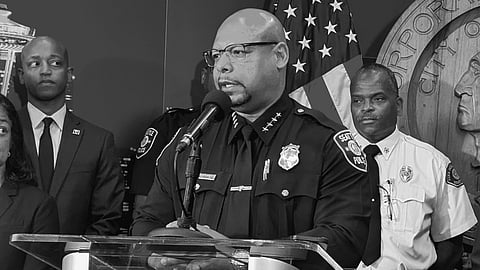
Seattle Police Chief Shon Barnes announced his resignation last week in the wake of the shootings at the Seattle Center. Barnes found himself on the hot seat when he was out of town for a conference when the shootings occurred, leading to political posturing and a media firestorm with rumors he would be terminated. Officially his resignation ended his tenure, which started in January 2025, and created predictable tension between the mayor and City Council. It also sparked claims from leaders of Black organizations that Barnes is being scapegoated and that the city's decision reflects anti-police and anti-Black politics.
There is a particular reflex in the Black community that emerges when one of our own reaches a significant position of power. We feel compelled to hoist them onto our shoulders, embrace their ascent as if it's our own, and defend them when we feel they face unjust treatment.
I understand that impulse. We are routinely denied opportunities to lead, and when one of us breaks through, there is a natural desire to protect that accomplishment. We know what it means to see Black people represented in spaces where we have historically been excluded. We hope that representation will somehow benefit us, perhaps by helping address the rampant anti-Blackness baked into our systems.
But as Princeton professor Ruha Benjamin has said, "Black faces in high places are not going to save us." She was pointing to Black proponents of "Cop City" within Atlanta's leadership class and Black ambassadors at the United Nations voting against ceasefires in Gaza.
I believe this is a conversation that should be extended to Barnes.
Context matters when we discuss discrimination and power dynamics. I don't believe the concept of discrimination applies as cleanly to a police chief as it does to other marginalized people navigating systems of power. In the same way that my support for workers and unions does not require me to support police unions, my opposition to racism, and specifically anti-Blackness, does not require me to defend every claim of discrimination made by a cop.
There are also substantive questions about Barnes' record that deserve attention.
Reporting from Divest SPD found that, based on a review of cases of officer misconduct that resulted in discipline, Barnes opted for the lightest punishment, against the recommendation of the Office of Police Accountability, nearly 70% of the time. This is significantly higher than his predecessor, Adrian Diaz.
None of this means Barnes deserved to be fired. But we have to stop getting distracted by the optics of who is sitting at the head of the table and start asking what the institution is actually doing for Black people.
Some of the criticism of his firing is being made in blatant bad faith. Right-wing media outlets have eagerly melded the story into a familiar narrative about a "radical socialist" mayor, in this case, Katie Wilson, targeting police officers. Others have raised legitimate questions about whether or not Barnes was treated fairly.
Is it possible that Barnes' firing makes him a scapegoat for the tragedy at the Bite of Seattle last month? Of course. But that danger always exists when installing a Black police chief to lead a largely white police force that has faced well-founded accusations of racism. And, in doing so, we risk both having a Black figurehead be used as a shield against valid claims of anti-Black policing, as well as running the risk of treating representation itself as evidence of meaningful change.
Collectively, I don't believe our energy is best spent defending police officers because that relationship has rarely been reciprocal. It's important to emphasize that more Black cops does not necessarily lead to reduced anti-Blackness in police departments. Research suggests that officers of color are often socialized into existing departmental norms and practices, which can override individual racial identities and reproduce the same institutional patterns of behavior.
Why should Seattle be unable to find a police chief who lives here? Someone whose primary home is here, whose family is rooted here, and whose investment in the city extends beyond the job itself? Barnes maintains his primary family home in the Chicago area, where his wife and children live full-time. That raises legitimate questions about what it means to lead a department responsible for serving and protecting people in a city where you do not appear to be fully rooted. In Chicago, for example, police officers are required to live within the city limits.
We should be asking whether our police department is accountable to the people it serves. Whether misconduct is meaningfully addressed. Whether hiring standards are rigorous. Whether Black communities are safer and more empowered. These are the questions I hope are front of mind as we search for our new chief.
It is now widely recognized that modern policing in the United States evolved in part from slave patrols. Today, policing continues to disproportionately surveil and use force against Black communities. I cannot bring myself to feel aggrieved on behalf of the people who uphold that system, regardless of their race.
Our communities do not need more symbolic representation without structural transformation. With this renewed emphasis on community safety, now is the time to step back and determine what we actually want to demand going forward.
Gennette Cordova is an award-winning writer and communications strategist focused on advancing racial equity and community-driven change. Rooted in amplifying underrepresented voices, she seeks to challenge dominant narratives and connect issues to broader movements for justice.
No Paywalls. No Billionaires. Just Us.
We're building a newsroom rooted in community, not corporate backing. Help us raise funds to hire our first-ever full-time reporter and grow our capacity to cover the South End. Donate today.

