
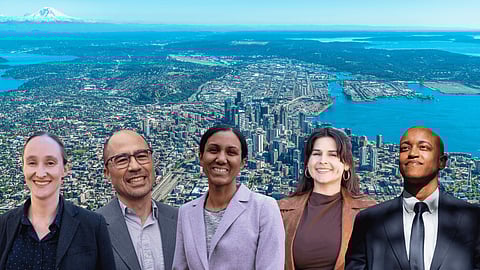
Seattle, King County Leaders Promise Climate Action — Accountability Next

For all the dynamic changes that have happened in U.S. politics over the past year — from the Trump administration's escalated measures in immigration enforcement and use of military force in U.S. cities to the Department of Energy banning specific words, such as "climate change" — Seattle stuck with its typical blue wave of votes during the November 2025 elections.
A progressive slate of newly elected officials, including Mayor Katie Wilson and King County Executive Girmay Zahilay, grounded their messaging in promises for more affordable housing, better transit, and efforts to curb the effects of climate change — which disproportionately impact South Seattle.
"We're at a crucial time for climate action," Wilson said in an email to the Emerald. "And with the Trump administration moving us backward, local leadership matters more than ever. But instead of setting a national example, Seattle's climate pollution continues to rise when it should be falling."
Now, four months after the election, we've focused on electeds who will have a substantial impact on South Seattle, and we asked each winner one question: What do their records and policies mean for the environment in the South End?
To examine how local officials intend to respond, the discussion turns first to Seattle — starting with Katie Wilson.
Katie Wilson, Mayor of Seattle
Katie Wilson narrowly defeated incumbent Mayor Bruce Harrell by about 2,000 votes. She ran mainly on affordable housing and transport, but her website makes it clear that climate action and environmental justice are key parts of her platform.
Specifically, Wilson emphasizes climate action, wildfire and heat resilience, and transit-first policies, including creating a "superblock" in Seattle, an urban traffic planning approach designed to reduce vehicle speeds and discourage through-traffic in residential areas. She cofounded and led the Transit Riders Union (TRU), a member-run union of transit riders organizing for better public transit in Seattle.
While leading TRU, Wilson helped organize the coalition that won King County's reduced‑fare ORCA LIFT Program, which now serves tens of thousands of low‑income riders, and played a critical role in other transit affordability programs, like the Seattle Youth ORCA passes that eventually inspired statewide free youth transit. Her website lists transit-related action items, such as expanding bus service, accelerating tree canopy and urban heat mitigation, prioritizing infill housing near transit, investing in distributed solar, and creating green jobs. And her transition team includes climate and transit experts, including policy-area co-leads Shemona Moreno, executive director of 350 Seattle, and Anna Zivarts, program director of Disability Mobility Initiative.
"Seattle has established official goals more than a decade ago, including 58% emissions reduction below 2008 levels by 2030, with specific targets for transportation and buildings," Wilson said. "But we're not even tracking our progress successfully right now. The City hasn't released emissions data since 2022 or travel mode data since 2019, so it's impossible to know how far we're off track. One specific goal is to start tracking these metrics again so that people can actually assess where we're at."
For South End neighborhoods, Wilson's focus on reducing vehicle miles traveled, along with bus improvements and zoning for more housing near transit, could help lower air pollution near highways. And her tree-canopy and heat-mitigation commitments could reduce urban heat island impacts in neighborhoods with low canopy cover.
However, these outcomes will depend on funding and project timelines; with city mode-share data fragmented, Wilson's stated commitment to frequent, public progress metrics would allow South End residents and advocates to hold her accountable.
"Seattle has systematically underinvested in working-class communities and communities of color, leaving them with higher pollution, worse flooding, and less access to green space," Wilson said. "My administration will work directly with community groups in South Seattle and other impacted neighborhoods to change that history and ensure that investments go where they're needed most, including investments in transit, housing, green space, and climate resilience hubs."
Eddie Lin, Seattle City Council, District 2
Eddie Lin won decisively in the District 2 special election, which spans the communities from the Chinatown-International District to Rainier View. This district is dense, diverse, and on the frontlines of exposure to pollution from the highways, the Port of Seattle, and the airport.
Lin's campaign centered on housing affordability, public safety, and fiscal reform; his platform emphasized economic justice, governmental accountability, and investing in services like health care. The Urbanist highlighted Lin's support for transit-oriented development and neighborhood investments, which can be supportive of lower car dependence.
Lin's campaign website doesn't have an in-depth environmental policy page. He previously worked in the Office of Housing, which may inform his equitable housing and sustainability approaches, but explicit environmental commitments are sparse in the public record.
In an interview with the Emerald, Lin said the disproportionate impact of climate change on South Seattle "has gone back for decades, and it has real impacts on people's life expectancies. In South Park, the life expectancy is 10 years less than the rest of the city due to air pollution, noise pollution, and the stress on families. Oftentimes, city government ends up putting large infrastructure through certain neighborhoods and not others, whether that's a highway or some other polluting facility."
Lin says city officials can instead focus on making neighborhoods healthier and safer. "This is a critical moment as we reimagine our built environment, because these planning decisions are oftentimes at the heart of environmental justice. We need to start trending in a better direction by transitioning away from a car-centric transportation system and toward more dense, walkable, affordable neighborhoods. Not only are vehicles one of the major contributors to our climate crisis, they're also dangerous and are killing our neighbors. … Some of the most important work we do is not going to have an immediate result, but it's going to have an enormous long-term result. How do we measure those things? I just have to think about that."
Dionne Foster, Seattle City Council, Position 9
Elected to Seattle City Council, Dionne Foster brings experience as a climate policy analyst and nonprofit leader. Position 9 is an at-large seat that enables influence on citywide climate and equity priorities.
Foster's climate policy work was with Puget Sound Sage, a nonprofit that advances policies for climate, economic, and racial justice. Her campaign emphasized climate justice, sustainable transportation, and equitable energy access.
As a newly elected City Councilmember, she says her top priorities for addressing environmental and climate issues in Seattle include creating high-paying jobs tied to clean energy, building retrofits, and climate resilience; land-use transportation solutions; and partnering with tribal governments.
"I also look forward to ensuring the metrics we're tracking align with our priorities to lower costs and improve the livability of our city," Foster said in an email to the Emerald. "That includes: looking at measuring climate impact through cost savings in utility bills, such as tracking the effect of using more energy efficient technology like electric heat pumps … [and] closing tree canopy gaps in historically redlined neighborhoods that experience disproportionate cumulative impacts to health like asthma for example."
Her at-large role means she can push for citywide policy changes that benefit frontline neighborhoods, but effectiveness will depend on budget negotiations, and whether she succeeds in tying city investments to measurable outcomes will depend on stronger and more routine data releases, as both she and Wilson alluded to.
"As a mom raising my 12-year-old son in South Seattle, this is a top priority for me," Foster said. "We must ensure that we are investing our climate adaptation and resilience efforts in communities that are disproportionately impacted by climate change. These communities are often located in redlined neighborhoods that experienced years of disinvestment in critical infrastructure in both the built and natural environment and experience the impacts of climate change. Climate interventions, such as community climate resilience hubs, investments to heat and cool community-owned and community-serving buildings, and expanding tree canopy coverage, can go a long way in protecting community elders and young people from extreme heat or extreme cold."
Alexis Mercedes Rinck, Seattle City Council, Position 8
Alexis Mercedes Rinck won reelection to continue serving Seattle's Citywide Position 8 seat, another at-large position.
On her campaign website, she frames climate resilience as inseparable from equity, recognizing that working-class and frontline communities often bear the worst impacts of heat waves, pollution, or displacement from climate change.
She supports investments in clean energy, electric heat, multi-modal transit, and transit-focused mobility to reduce carbon emissions and to provide accessible, sustainable transport alternatives.
"We know that over 60% of our city's emissions actually come from transportation," Rinck said in an interview with the Emerald. "We got a statement of legislative intent — so essentially we're requiring [the Seattle Department of Transportation] to report on the city's measurement of transportation project impacts as it relates to climate, and we're getting that report this year."
In office, she has already acted: In 2025, she co-launched a "Better Bus Lanes" campaign to preserve transit-reliant infrastructure and support public transit usage.
Rinck's emphasis on clean transit and electrification could reduce transportation emissions and improve air quality citywide. And her support for reliable, bus-based transit could also help reduce driving, cut emissions, and increase equity in access to work and services.
"This year, we're going to be renewing the Seattle Transit Measure," Rinck said. "This is a measure that actually buys additional bus service for many of our equity priority routes — late-night bus service so folks are able to get home at night — super important for a lot of South Seattle. This adds extra bus service and funds our ORCA LIFT Program. So when we're talking about making transit accessible, easy to use, this is going to be a really critical measure that we're taking up this year."
However, she also mentions the importance of measurement, and she says no intermediary steps or benchmarks have been established. "We're going through a 10-year plan update for our Climate Action Plan, and my first request of [the Office of Sustainability and Environment] was, we need to set intermediary goals — how are we actually getting there? We need to commit to these intermediary short-term steps, setting clearer metrics, and developing a dashboard where we are seeing how much progress we're making, not just a horizon goal of 2050."
Girmay Zahilay, King County Executive
Turning now to the broader region, leadership at the county level also shifted, with Girmay Zahilay taking the reins as King County executive and bringing new climate and governance priorities to the county's sweeping jurisdiction.
Zahilay entered office with strong backing across Seattle and South King County. His South Seattle upbringing ties him to frontline communities and his governing blueprint — King County Delivers — signals a results-driven administration focused on accountability, equity, and measurable improvements in quality of life for King County residents.
Endorsed by Washington Conservation Action, Zahilay's platform placed climate action as a top priority. He called for a 50% reduction in greenhouse gas emissions by 2030, stronger anti-sprawl land-use planning, transit-oriented growth, and major upgrades to wastewater and stormwater systems. He emphasized habitat restoration, green infrastructure, and a clean-energy workforce pipeline.
Zahilay's framework emphasizes transparency and accountability, calling for quarterly performance reports from major county departments to track progress toward departmental goals. His record on the King County Council included consistent environmental work, including advocating for Extreme Heat Mitigation legislation, resulting in a first-of-its-kind extreme heat strategy in King County.
For South End and frontline neighborhoods, his focus on wastewater modernization, sewer overflow reduction, and Duwamish cleanup, as evidenced by his time on County Council, could be particularly consequential. His anti-sprawl stance and emissions-reduction targets rely heavily on coordination with Seattle, regional utilities, and state agencies.
"Last fall, the King County Council — including then-Chair Zahilay — approved the 2025 Strategic Climate Action Plan (SCAP)," Callie Craighead, press secretary for the King County Executive Office, said in an email to the Emerald. "This plan sets the blueprint for climate action in King County over the next five years across nine different areas, from transitioning to clean energy, strengthening local food systems, restoring ecosystems, and reducing waste. Executive Zahilay will use this action plan to inform his policies and is especially interested in creating new green jobs in frontline communities and growing our region's clean energy workforce. … For metrics, our office will be working with county and state agencies to track multiple indicators of environmental health, including air and water quality, equitable access to green spaces and urban tree canopy, floodplain and habitat restoration, and more."
Bold Climate Agendas — the Proof Comes Next
As many of them mention, the climate promises of this new leadership cohort will hinge on measurement. Their effectiveness will depend on transparent, routine reporting that gives residents data to track progress and hold officials accountable to the improvements they promise.
Lauren Rosenthal is a graduate student in the University of Washington’s Communication Leadership program and a communications strategist for the Center for Journalism, Media, and Democracy. Her freelance journalism has appeared in Formidable, the South Seattle Emerald, and College Magazine.
The Emerald's environmental reporting is funded in part by the City of Seattle's Environmental Justice Fund.

No Paywalls. No Billionaires. Just Us.
We're building a newsroom rooted in community, not corporate backing. Help us raise funds to hire our first-ever full-time reporter and grow our capacity to cover the South End. Donate today.
