
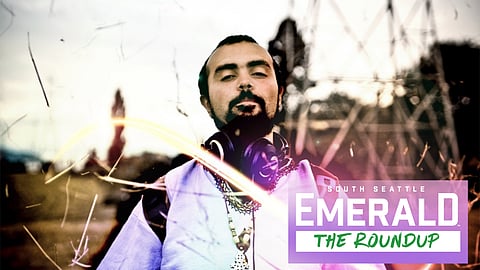
The Roundup: The Song You Need When Protesting ICE

From the Editor
What's up, South End?
The big news this week is that President Trump fired Homeland Security Secretary Kristi Noem.
Trump has tapped Republican Sen. Markwayne Mullin of Oklahoma as Noem’s replacement. Noem had become the face of Trump’s deportation efforts and has come under scrutiny following the killings of U.S. citizens by ICE, including the two recent murders in Minneapolis.
Now, her reign is over, but it's not yet clear if any changes to immigration enforcement will come in the near future.
This is a topic that many Americans are grappling with and one place to look in these times for a bit of insight is the arts.
Local hip-hop artist Gabriel Teodros has a new song, Pow, which addresses the current state of affairs regarding ICE and immigration enforcement. The song is a clever flip of Goodie Mob’s mid 90s hit Cell Therapy.
I recently spoke with Teodros about his new song, what inspired him to write it now and if hip-hop can still be a soundtrack to revolution.
The interview has been lightly edited for length and clarity.
MD: There’s a lot happening in the world and in our country right now. The news is inescapable. But, was there a specific event that led you to write this song now?
GT: It started last summer with my band. A lot of times I do shows with just instrumentals, but when I'm able to, I do shows with a live band. And I have this song called Distance and I was just messing around at the house, and I started like putting the verses over the Goodie Mob Cell Therapy instrumental just to see how it would sound. Then I had the idea of, like, what if I update the chorus and make it about ICE? That'll make it feel really current. Then I performed it at a couple of shows.
One show in particular was this year. It was the Radio Gaza event at Black and Tan Hall in January. And with everything that ICE has been building and building — and to answer your question directly, about what event sparked this, it was the ICE takeover of Minneapolis. Just seeing and hearing the stories coming from there and always thinking that Minneapolis and Seattle have a lot in common in terms of the communities that live here. The fear that came from hearing those stories, but also the hope that came from seeing the way people in Minneapolis banded together and fought back to protect each other — I wanted to capture all of that in the song.
Doing the version of Distance with the chorus that ended up on Pow at Radio Gaza and seeing the way the crowd responded to that song, it was, like, higher than anything else that happened that night for me. So I went home and made that a real song complete with more relevant verses. I recorded it and put it out a week later.
MD: In these moments that we are living through now, I keep asking myself: Where is hip-hop? Speaking to these moments used to be so much of hip-hop's identity. Is hip-hop missing the moment? Or am I just missing the artists that are capturing it?
GT: You're not wrong at all. And I think the song is two things at once: It's a reflection of the current times, and it also pays homage to Goodie Mob’s “Soul Food” from 1995. That album went gold in its time. That was a single that you could watch on television. And they were talking about fighting back against the government, just like I am on Pow in 2026. It’s about ICE, but it is absolutely built on what the Goodie Mob was talking about back then. And that was a mainstream group, so no, you are not wrong.
I would say mainstream hip-hop is missing from the conversation. But, I do think there's a lot of people that don't have that kind of huge platform, people like Bambu, people like Rebel Diaz, Bobby Sanchez, The Neighborhood Kids you know, who have been talking about it the whole time. And those are just a few examples. But when it comes to our bigger, more household names, they've been quiet about a lot of things these last five years to be honest.
MD: Do you still have hope in this moment?
GT: I have hope when I leave my house. I'll say that. I have hope when I get offline and I stop doomscrolling and I see that people are activated. But I have to go out and be with the people to see it. The young people give me hope. It’s interesting, the day I released the song, coincidentally there was a huge student walkout the next day. And I got messages that some of the kids had speakers, and they were playing the song at the walkout. That gives me an incredible amount of hope.
MD: On that same note, when is the next time people can come together to hear the song live? When is your next performance?
GT: March 21, 8pm, at Black and Tan Hall. My homegirl Jenn Johns from Oakland is headlining, and I'm doing a group set with Khingz, Shakiah and Rell Be Free. It’ll be really special. Four artists from the South End performing together in the South End.
The Roundup Rundown
Local leaders, including Seattle Mayor Katie Wilson, King County Executive Girmay Zahilay and multiple Seattle city councilmembers are looking to cut emissions, expand transit and protect frontline neighborhoods.
Contributor Lauren Rosenthal reports the group now has clearer metrics to track progress.
Wilson told the Emerald via email, “We're at a crucial time for climate action. And with the Trump administration moving us backward, local leadership matters more than ever…. Seattle's climate pollution continues to rise when it should be falling."
Rosenthal examined what the plans of local leaders will mean for the South End. You can read her full article here.
Summer of Love, the Summer of Protest, the year the world stopped — however you name the events of 2020 when they pop into your head, for many of us they all go back to a certain moment. And a certain place: The CHOP.
A lot happened that summer and in the following months, but for a moment in time, Seattle was in the epicenter of national news coverage in the wake of George Floyd’s murder, and the Capitol Hill Occupied Protest was ground zero.
Columnist Gennette Cordova has written about those times, including this 2022 article about the self-proclaimed (and right-wing media anointed) Raz Simone, who infamously, among other things, recorded a music video on top of a Tesla during the protest.
In the days of the CHOP, and after, multiple women women accused Simone of sexual abuse and traffiking.
Now, four of those women have won a civil case against Simone. Gennette has the details about what these events mean in her latest column.
Artist and writer Laura LeMoon’s photo exhibit, What the Earth Knows, reflects on the victims of Green River Killer Gary Ridgway, who targeted sex workers.
The photos are currently on display at Lottie's Lounge in Columbia City.
Contributor Lauryn Bray recently interviewed LeMoon about the exhibit and the events, and people who inspired it.
You can read Lauryn’s full article, and see a few of the photos, here.
Sign Up for More!
This is an abbreviated version of The Roundup newsletter. To get the entire newsletter, including a weekly list of events to check out and my shout-out to South End Gems, subscribe here. See you next week!
Mike Davis is the newsletter editor and Voices editor at the South Seattle Emerald. Born and raised in Seattle's South End, Mike is a longtime journalist who's covered everything from arts and culture to sports to politics.
No Paywalls. No Billionaires. Just Us.
We're building a newsroom rooted in community, not corporate backing. Help us raise funds to hire our first-ever full-time reporter and grow our capacity to cover the South End. Donate today.
