
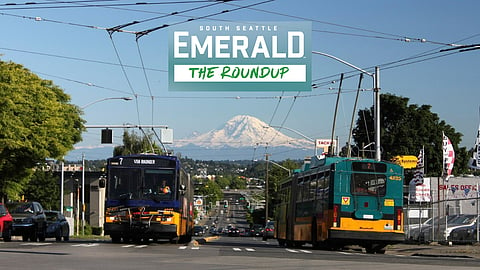
The Roundup: Route 7 or RapidRide? Zahilay Weighs In

What's up, South End?
Last week, we talked about potential changes to bus Route 7.
We got plenty of feedback from concerned community members, so I wanted to do a follow-up.
This week, I interviewed King County Executive Girmay Zahilay.
We spoke about the proposed changes to Route 7, the feedback the Emerald has heard from the community, and the current status of the proposal.
This interview has been lightly edited for length and clarity.
MD: After running our article last week, we've heard plenty of feedback from the community. What are your thoughts on the proposed changes? Do you support changing Route 7 to RapidRide R?
GZ: I definitely support RapidRide R and upgrading Route 7 because I think the South Seattle community deserves an upgrade, deserves the best possible transit service and the better overall rider experience that RapidRide brings. I think there's a lot of work to do to make sure that we're incorporating community feedback and being as accessible to all of our communities as possible. And so I want to continue working with our community to make this the best possible investment for the neighborhoods that I grew up in and care about.
MD: A question that keeps coming up is why we can't have both Route 7 and the RapidRide. Why does it have to be either or?
GZ: I think in a universe where we had unlimited resources, maybe it could be. But when you take finite resources and divide them between two projects, two different sets of buses, two different operators, two different systems that could end up with us having less of both, I don't think that's something anybody wants. And they might also interfere with each other. You know, the benefits of RapidRide are the reliability, the frequency, and having a local bus that is competing with that bus lane could present problems too.
MD: I get that. But what I'm hearing from the community is concern over the loss of 20 stops in our neighborhood. That makes it feel like a shift toward a commuter bus for getting downtown that will replace a route that has traditionally been a lifeline for people in the community traveling within the South End. A lot of people say this will make daily life harder. So I ask: Who does this serve? Is it primarily for people commuting to work downtown?
GZ: It can and should serve everyone. No one should be left behind. Not our seniors. Not people with disabilities. Not people who want local access. And not commuters. And that is a conversation that's ongoing to make sure that it does serve all of our communities.
I would not be supporting this if I didn't think it was going to be a better experience for everyone. A RapidRide R is going to have more dependable buses. It's going to have safer ways to reach the bus because of all of the infrastructure improvements that come with RapidRide. We know that a lot of parts of Rainier are treacherous, and so the better lighting, better sidewalks, better access is something that's going to be better for everyone. We're going to have more comfortable places to sit and wait. We're going to have signals that tell people when the bus is coming. The bus timing between each bus is going to be more reliable because it's going to be managed through a better system.
And, in terms of stop consolidation, I definitely hear people are wanting to preserve stops that they rely on. And because of that feedback, we've already added back in a couple of stops to the updated proposal, and I want to continue hearing from people.
I would also note that the stop consolidation piece really resonates with me, and that's why we've taken certain actions, and then we will continue to take actions. But the kind of blanket Route 7 romanticization that is happening is also not fair or accurate, in my view. You know, this is the route that I grew up taking, and until this RapidRide conversation started happening, it wasn't this kind of blanket romanticizing that was happening. Route 7 has had its fair share of issues.
MD: I also grew up taking the 7 and agree it has its issues. But I know there are still a lot of people who depend on it, many of whom have reached out with concerns about the proposals, and I know plenty of people who've voiced these concerns since 2019. It would be great to be able to communicate to them that they can have their voices heard.
GZ: Mike, can I ask you a question? When people are reaching out, are they telling you which specific stops that they are most concerned about, or are they giving you a vague concern about RapidRide in general? Because the people who are reaching out are not telling us specific stops. So the more they can tell you specific stops, the more we can be helpful.
MD: Our reporter Jacquelyn Jimenez Romero recently did a ride-along with a few community orgs and neighbors who pointed out the stops that would potentially be eliminated. She said people mentioned stops by schools and pharmacies.
GZ: Maybe that refers to Franklin. One of the stops we're adding back is on Rainier and Bayview near Mount Baker Station. Another one is on Rainier and Grand near Judkins Park Station. But again, the sense that I've been getting is that people, when they hear the number, you know, 20 stops being consolidated, that number, understandably, is making people feel like it's not going to be as accessible as it used to be. But I would really, really encourage people to sit with the map and see which ones are going to affect their lives most consequentially and then share that with us.
I think this is going to be a massive improvement for South Seattle. It's going to also be better connected to the light rail network. Right now, the 7 doesn't connect directly to the Rainier Beach Station, and the RapidRide is going to be better connected to Rainier Beach Station, Judkins Park Station, the International District, Mount Baker, and all of the downtown stations.
MD: Where exactly do we stand in this process? What are the next steps, and for the people who still want their voice to be heard before a final decision is made, how can they do so?
GZ: Today, I'm going to be transferring the alignment ordinance to the King County Council. That's going to be the ordinance that shows the stops for the RapidRide, and the Council continues to have the authority to review and add stops back in. So I would encourage the community to find out the King County Council's review schedule through the TrEE Committee — Transportation, Economy, and Environment Committee — come and testify and share again the specific stops that you're most concerned about.
Also, Metro will continue to have more community forums as we continue the design process of RapidRide, and there is a specific segment of the 7 that's going to experience the most consolidation, and those are what's called the Prentice Loop south of Henderson, and for those communities south of Henderson, Metro and myself will do a separate service process to make sure that we don't leave that community behind and make sure that they have the options that they need to connect to our transit networks, and that's going to be a commitment from me and Metro to make sure that we continue serving that community.
The Roundup Rundown
🚨 The Big One
After the shooting at the Bite, interim Police Chief Andre Sayles said SPD can't prevent shootings. If they can't, who, or what, can? Looks like we've known the answer for a long time.
👀 Word on the Streets
Even if you've never entered the funeral home on Rainier and Alaska, chances are you've gone by it a million times. It recently burned down, but now, it's coming back.
🏛️ Need-to-Know Politics
Election season is upon us. Here's what you need to know heading into November.
🍏 Community News
A Native-owned birthing center is coming to Columbia City. Here's why it's such a big deal.
Sign Up for More!
This is an abbreviated version of The Roundup newsletter. To get the entire newsletter, including a weekly list of events to check out and my shout-out to South End Gems, subscribe here. See you next week!
Mike Davis is the newsletter editor and Voices editor at the South Seattle Emerald. Born and raised in Seattle's South End, Mike is a longtime journalist who's covered everything from arts and culture to sports to politics.
No Paywalls. No Billionaires. Just Us.
We're building a newsroom rooted in community, not corporate backing. Help us raise funds to hire our first-ever full-time reporter and grow our capacity to cover the South End. Donate today.
