
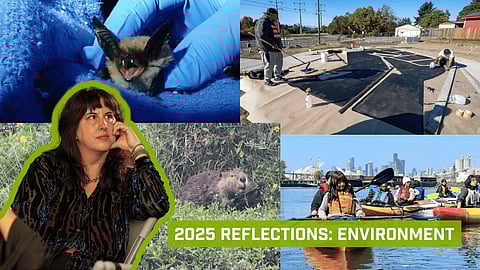
2025 Reflections: Looking Back at Environmental Justice Coverage

In mid-2025, after a few years at the Emerald wearing a few different hats, I became the Environmental Justice editor, granting me the opportunity to work with reporters and photographers to foreground the South End communities shaping their shared environment.
Underscoring our coverage is this oft-repeated context: The South End is disproportionately polluted in comparison with more northern parts of the city. It has fewer trees, fewer resources, more industry — and more diversity. That diversity drives the varied community-led approaches to healing, organizing, and educating shared in the following stories. As I reflect on this beat's published pieces this year, I see an abundance of passion and care, and a recurring focus on supporting youth in learning about and caring for their environments.
Starting with the earth and the people who work it: Jill Wasberg wrote about a South Park biodigester that's turning local food waste into fuel and fertilizer, while training BIPOC youth in STEAM (science, technology, engineering, arts, and mathematics) professions. So far, the fertilizer has been tested in several community gardens around Seattle, where it encourages plant growth. Youth can be involved in growing food as well as bringing food scraps full-circle in the biodigester.
Lauryn Bray covered Black Panther Park in Skyway, an under-construction park that "will showcase art designed by local artists … double as a community garden and herb pantry, and serve as a cultural incubator and communal space for Skyway residents of all generations," writes Bray. She interviewed Nurturing Roots Founder and Director Nyema Clark, who said, "[With all] the noise of the outside world, we wanted to create a sanctuary space where folks could just feel good and reconnect with community."
Next, into the waters, where one of Seattle's hardest-working creatures, the beaver, builds dams and provides essential yet unsung ecological benefits, which "are becoming increasingly valuable as climate change brings more extreme weather patterns to the Pacific Northwest." In his piece on beavers, Alex Garland honored the hard work of this charismatic animal as well as the people working to conserve it and introduce youth to their often-invisible neighbors, sparking interest in their surroundings.
On the Duwamish River, a paddle program heals land and legacy, wrote Vee Hua. The program offers "educational paddles designed to bring new audiences to a river that has long been neglected — and to help restore it." It leads cleanups and increases access to the water for numerous groups, including youth. And as it works toward a healthier future for — and understanding of — the Duwamish, it also looks to the river's history, working with Duwamish Tribal Services "on ensuring that the Indigenous history is front and center throughout the tours."
And Syris Valentine dives into flooding in South Park and the Duwamish Valley, profiling community organizations and city agencies that are working together to "ensure that the communities of the valley are as prepared as possible for what waters may come."
Finally, into the air. Jadenne Radoc Cabahug examined air pollution and asthma in the South End, where children have the highest rates of asthma hospitalization in Seattle, and she covered the local programs working to support impacted people and change policy. And though the topic is a serious one, the photos Meron Menghistab captured of the Patrick family will bring a smile to your face.
And taking flight into the Seattle night — or hibernating nearby — are bats, which are falling victim to white-nose syndrome, reported Caroline Guzman. Scientists are experimenting with a formula made to treat this plague, specifically for bats in the Pacific Northwest, and community science programs are involving residents in monitoring local bat populations and learning about bats' benefits to our environment, from pest control to pollination.
In the coming year, the Environmental Justice beat will continue chronicling communities' care for each other, the earth, the waters, and the air, in the South End and beyond. If you're looking forward to these stories, please support our work. And if you have tips or feedback, email me. Happy New Year!
Amanda Sorell is the environmental justice editor for the South Seattle Emerald. Based in Seattle, she brings more than a decade of experience editing and writing for homesteading magazines, with a focus on food access, farming, and foraging.
The Emerald's environmental reporting is funded in part by the City of Seattle's Environmental Justice Fund.

No Paywalls. No Billionaires. Just Us.
We're building a newsroom rooted in community, not corporate backing. Help us raise funds to hire our first-ever full-time reporter and grow our capacity to cover the South End. Donate today.
